
Does dystopian literature have a place in the classroom?
See what the author of Macrat’s study manual for ‘Brave New World’ has to say …
It is notable that some of the literary texts chosen by the IEB (for English Home Language) in recent years reflect concepts about dystopian societies.
A reader might ask: In what way are these literary works valuable for education?
There are several possible answers to this question.
Before addressing this question, it is important to identify the two texts for study in the IEB that reflect dystopian societies. One of them is Margaret Atwood’s The Handmaid’s Tale. The other is Aldous Huxley’s Brave New World. These books are choices for Grade 12 for English – Atwood’s book is currently prescribed and Huxley’s book is prescribed for 2025 and the years thereafter.
Atwood’s book is a reflection of a dystopian society because the society is controlled by an authority (a group of men) that limits freedoms in the society. In particular, the freedoms granted to women are very reduced if the reader reflects on the differences between Atwood’s depiction of a society (Gilead) and societies which embrace democracy. In Gilead there is a restriction on opportunities in terms of work, and a restriction on the opportunities for education. Critical thought is not encouraged in this society. The society does not encourage the citizens to ask: What if?
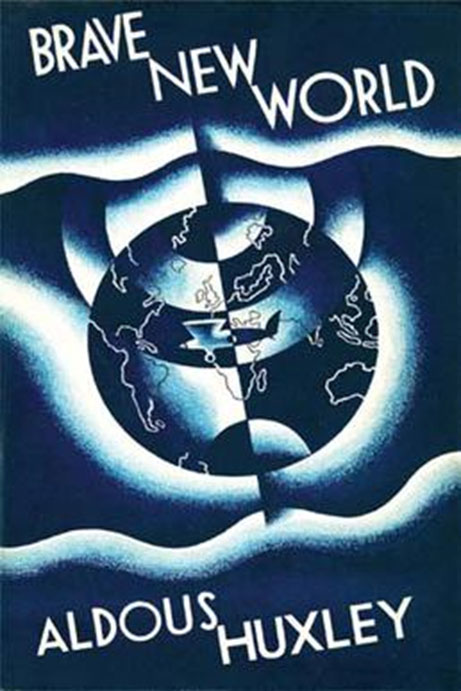
History is not considered important in the World State. In this social situation people do not know the struggles of the past. The citizens do not have knowledge about how the society has developed or changed and why the society has evolved as it has done. People in that society do not know their own histories as individuals or as a group. In addition, individual freedom is regarded as less important than the group’s stability. Mustapha Mond (the World Controller for Western Europe) quotes Henry Ford – “History is bunk”. However, Mond himself is aware of historical changes, so he is hypocritical.
In The Handmaid’s Tale the Commander (the figure of male authority in the novel) is also hypocritical – he acts against the laws and norms of the society that he states are necessary. In both of the novels, therefore, there are characters who have positions of authority who act hypocritically.
In both of the novels the authorities act against people who rebel, but in very different ways. Individual freedoms are restricted and the authorities see compliance to social norms as part of the greater good.
One of the figures of rebellion in Brave New World is John, who was raised in Malpais (outside of the World State) and who was therefore socialized differently from the citizens of the World State. When he travels to London with Bernard Marx and Lenina Crowne, accompanied by his mother, Linda, John experiences a very different world from his own lived experience and his anticipated experiences in the city. John takes his own life after experiencing the world of the city and the surrounding areas. In terms of dystopian fiction, it would seem that the individual is so pressured by the expectations of the society, that there is no point to carry on living.
These two dystopian novels present the reader with a narrative of societies that require compliance with laws created by the authorities. They also show societies that will act emphatically against people who show rebellious tendencies.
One aspect of a dystopian society is that they are presented being utopian ideals that have gone wrong. In other words, no societal planner has the vision that a dystopia is a good idea. Instead, the people who plan for the society’s governance, tend to think that their plans are good ideas about how a society should be governed. However, because these plans do not accomplish a dream of a perfect world for every citizen, these plans fall short of being utopian.
It must be noted that dystopian novels tend to reflect about fictional societies (often set in the future). Because the writers of such novels do not have a perfect view of the future, they tend to leave out things that exist in our world today. Huxley and Atwood have not included the Internet, social media or anything like it. Through technological means the societies across the world today have access to a range of sources of information. However, there is also misinformation on the Internet. Access to information and the ability to interact with many people suggests that the control of education (as in Gilead and the World State) is unlikely to happen. We must remember that there are countries in which freedoms to find information are restricted because search engines and technological applications can be managed/controlled through a country’s laws.
At this point I return to the question posed at the start of this document – In what way are dystopian novels valuable for education? The point of studying dystopian fiction is that these novels tend to raise the questions: How are we to live? How are our societies to ensure that the dreams of each of the citizens can be realized? How are societies to be governed? What are the possible repercussions for a state in which governance is poor?